A guitar humidor, also referred to as an instrument humidor, is a climate-controlled enclosure: freestanding cabinet, wall-mounted case, or custom built-in, designed to maintain the ideal humidity environment for storing and displaying guitars and other stringed instruments. The term is borrowed directly from the world of fine cigars, where humidity control is equally essential to preservation. Applied to instruments, it describes the same principle: a sealed, actively regulated environment that protects the organic materials inside from the humidity fluctuations that cause irreversible damage over time.
If you own guitars worth protecting; vintage instruments, luthier-made guitars, collector’s items, or simply guitars you’ve played for years and intend to play and pass down to another generation, understanding what a guitar humidor is, how it works, and what to look for is essential.
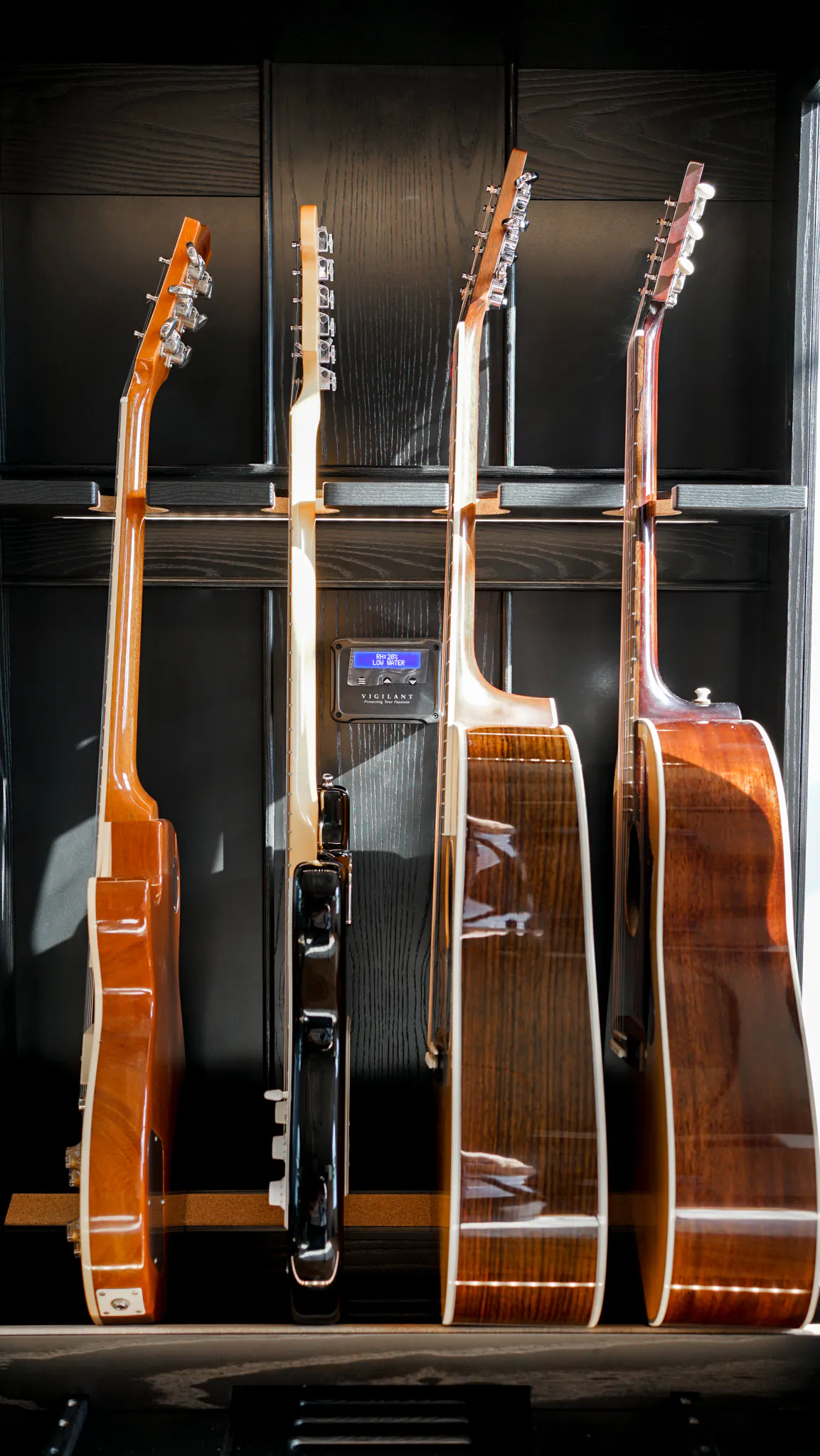
Why Guitars Need Humidity Control
Wood is a porous material. It absorbs moisture when the surrounding air is humid and releases it when the air is dry — expanding and contracting with every seasonal change, every blast of central heating, every summer thunderstorm. This movement is the primary cause of guitar damage, and it’s entirely invisible until the symptoms appear.
The safe humidity range for guitar storage is 40–60% relative humidity (RH), with the target being 45% at 70°F year-round.
What happens below 40% RH:
- Fret ends protrude and become sharp as the fretboard wood shrinks around them
- Tops crack — particularly on acoustic guitars, behind and around the bridge
- Bridges lift and separate from the guitar top
- Glue joints loosen throughout the instrument
- Finish checks and crazes on nitrocellulose lacquer finishes
- Neck relief shifts causing playability issues and fret buzz
What happens above 60% RH:
- Tops swell and belly upward, raising action and distorting the guitar’s geometry
- Frets corrode and oxidize, developing rust that makes string bending rough and abrasive
- Necks warp in extreme cases
- Finish clouds as moisture works beneath the lacquer
- Mold can develop inside hollow body instruments in severe conditions
Both directions of humidity failure cause real, often irreversible damage. Both are preventable with the right storage solution.
[Read the full humidity guide: Guitar Humidity: Everything You Need to Know
Guitar Humidor vs. Guitar Case: What’s the Difference?
A standard guitar case — even a high-quality hardshell — provides physical protection against impact and some insulation against rapid environmental changes. It does not actively control humidity. A guitar stored in a closed hardshell case in a dry room is sitting in a sealed, dry environment. Without an active humidification source inside, the case simply traps the ambient conditions of the room.
Soundhole humidifiers and two-way humidity packs (like Boveda) improve on this by introducing a passive moisture source inside the case. These are a reasonable option for travel and short-term storage, but they require regular monitoring, frequent replacement, and offer limited effectiveness in climates with extreme or rapidly changing humidity.
A guitar humidor (in the true sense of the term) contains an active humidification system: a powered unit that monitors the humidity inside the cabinet and adds or removes moisture automatically to maintain the target range. No daily checking. No pack replacements. No guessing about whether the humidity inside has drifted while you were away.
What a Proper Instrument Humidor Contains
Not every product marketed as a “guitar humidor” provides genuine active humidity control. When evaluating any instrument humidor, look for the following:
Active Humidification System
The core requirement. A true guitar humidor contains a powered humidification unit that automatically maintains the interior at the target humidity level — typically 45% RH. Look for:
- Automatic operation (no manual triggering required)
- Low noise output (critical for recording environments)
- Low maintenance requirements (refill frequency, ease of access)
- Adequate capacity for the cabinet size and number of instruments
Optional Dehumidification
For players in tropical climates, coastal environments, or geographic areas where ambient humidity regularly exceeds 60%, the ability to remove moisture from the cabinet is equally important. AMF’s Guitar Habitat and Guitar Estate models offer an optional integrated dehumidification system for this purpose.
Learn more: Dehumidifying a Guitar: What You Need to Know
Finish-Safe Interior Materials
The materials inside a guitar humidor must be chemically inert relative to your guitars’ finishes. This is particularly critical for nitrocellulose lacquer — the finish used on virtually all vintage instruments and many high-end modern guitars — which can react with foam, certain rubbers, and other off-gassing materials to cause permanent finish damage.
Interior materials should use natural cork, leather, or similarly inert materials at all contact points.
Sealed, Patented Door Design
The door system is the most critical component for maintaining a stable interior climate. A poorly sealed door allows humidity to escape and ambient air to infiltrate, making consistent climate control difficult or impossible regardless of how capable the humidification unit is. AMF’s guitar humidors use a patented door design developed specifically to maintain the ideal internal humidity year-round, regardless of the ambient humidity level in the surrounding room.
UV-Protective Glass
Light is a secondary threat to guitar preservation. UV exposure causes finish fading, wood bleaching, and plastic deterioration over time. Quality guitar humidors use Low-E or tempered glass with UV-blocking properties to protect instruments from light damage.
AMF Guitar Humidors: The Complete Lineup
The Nashville Guitar Habitat — Wall-Mounted Guitar Humidor (1–2 Instruments)
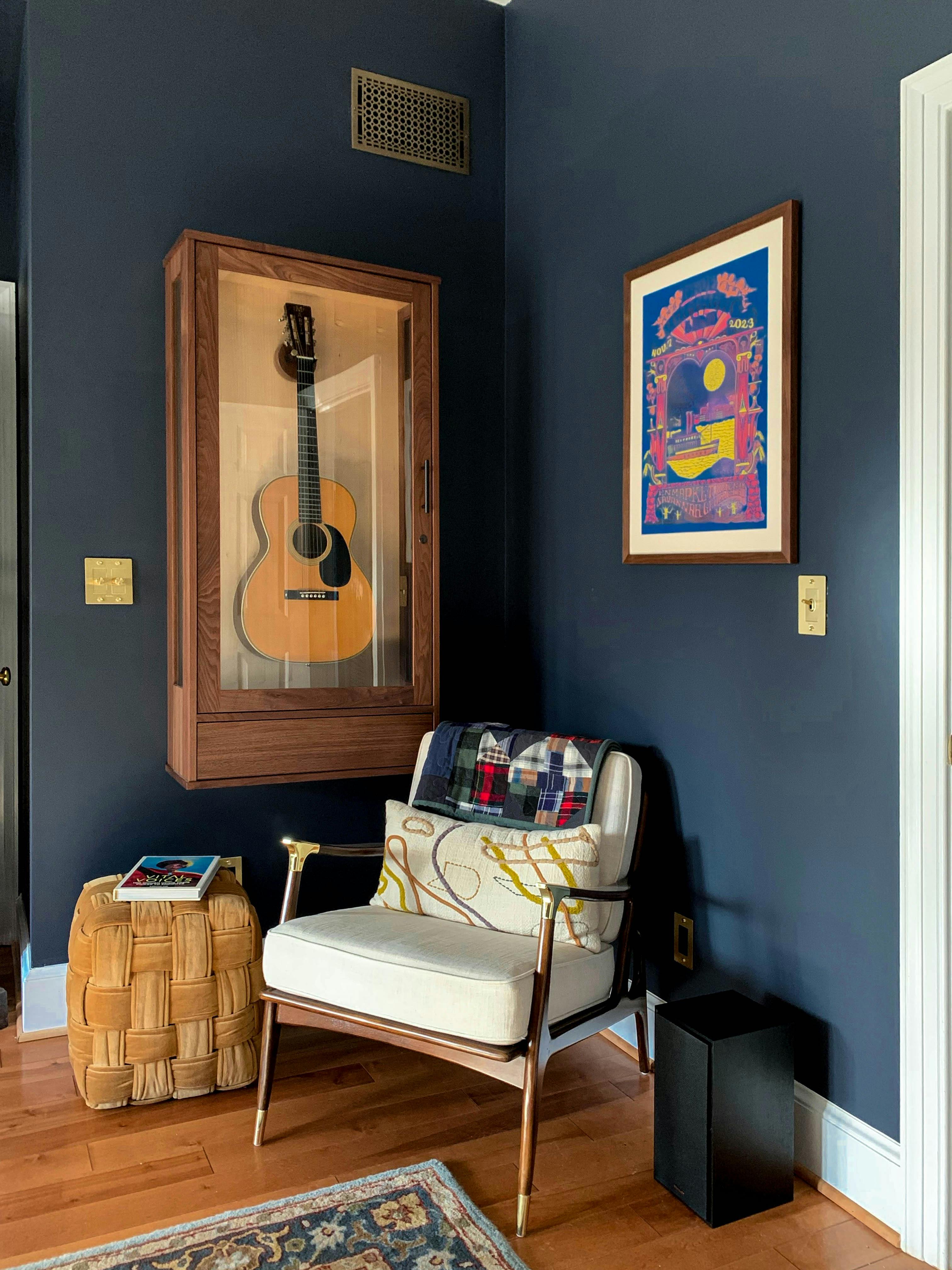
The Nashville Guitar Habitat is AMF’s wall-mounted single-instrument humidor. It combines solid hardwood construction with an optional 1.5-quart active humidification system in a wall-mount display format — presenting your guitar as a framed work of art while maintaining the climate conditions it needs.
Features:
- Optional 1.5-quart active humidification system
- Silent operation — comparable to a laptop fan
- Glass door with lock and key
- Dimmable LED lighting
- French Cleat mounting system
- Available in 5 hardwoods: Cherry, Maple, Natural Oak, Black Ash, Walnut
- Accommodates all guitar body types including jumbo acoustics and archtops
The Double Nashville offers identical specifications for two instruments displayed side-by-side.
Shop Nashville Guitar Habitats
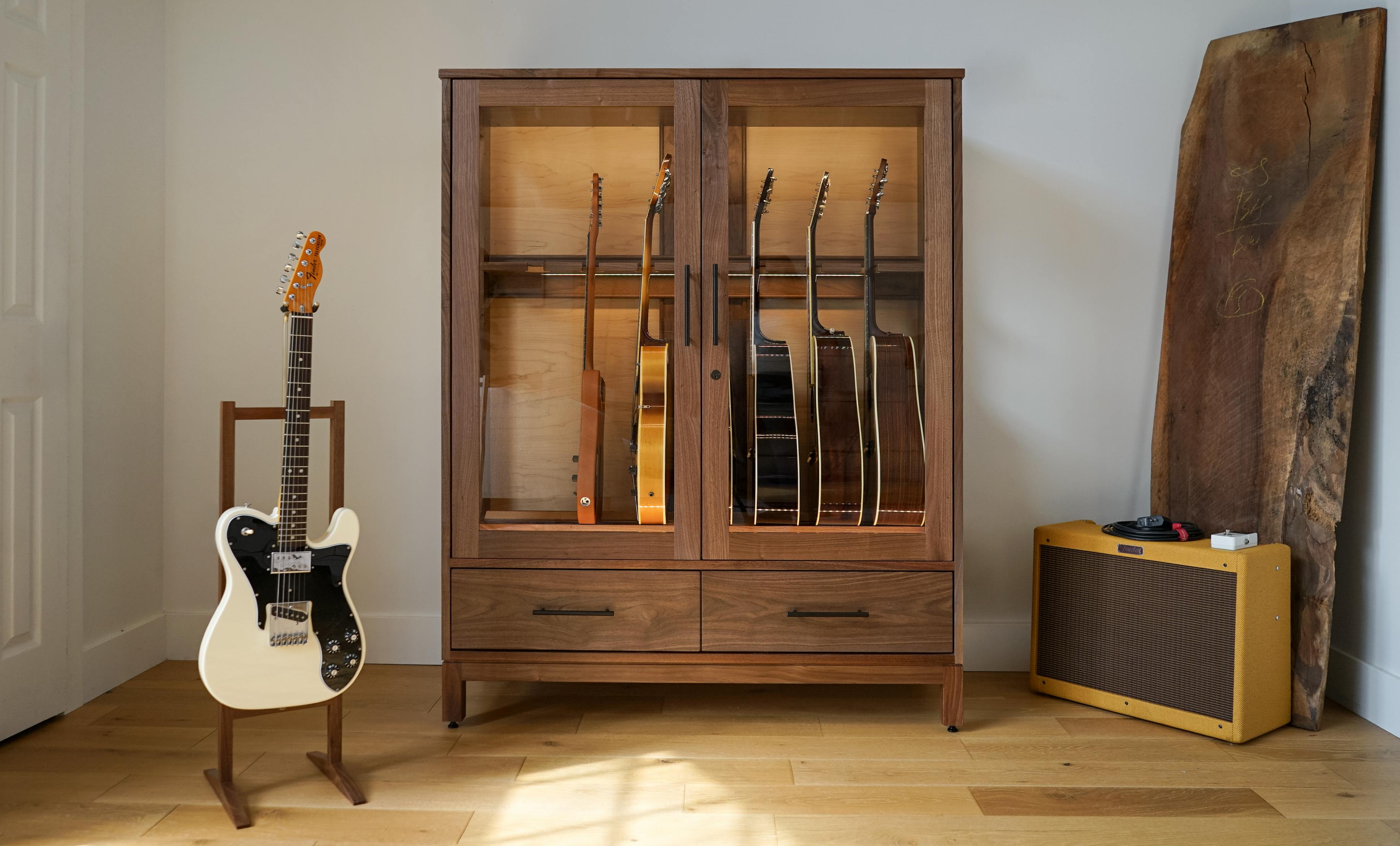
The Guitar Habitat — Freestanding Guitar Humidor (4–10 Instruments)
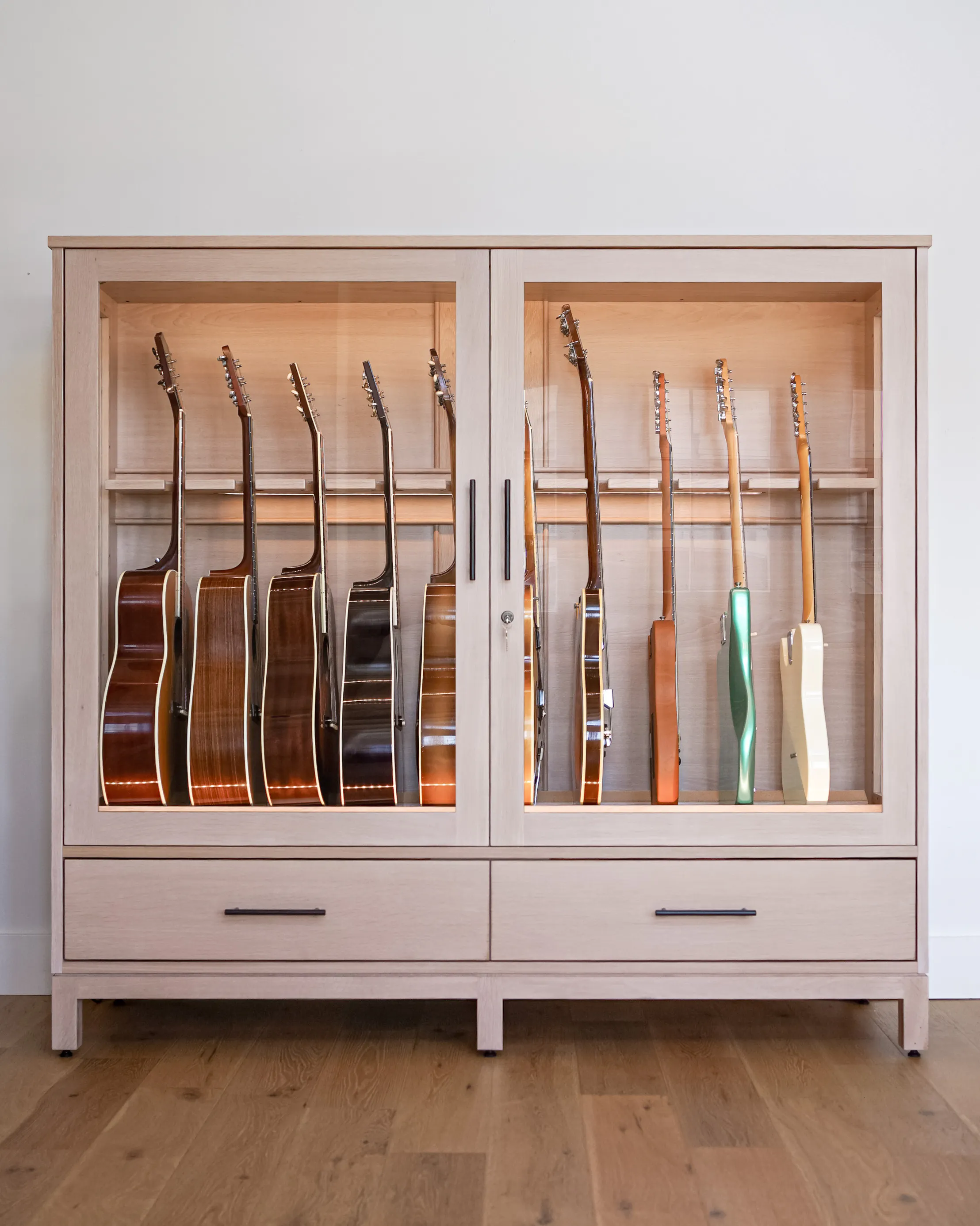
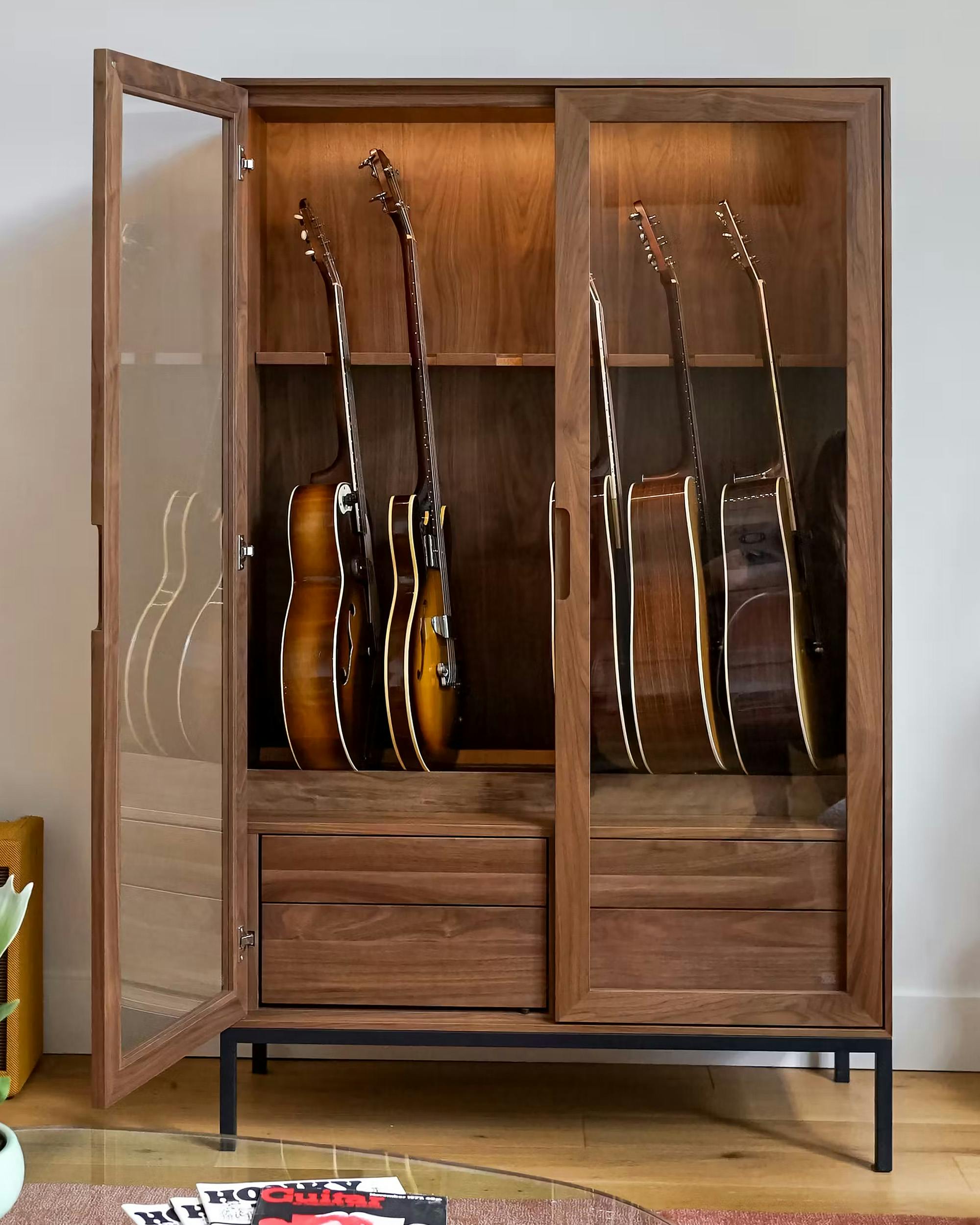
The Guitar Habitat is AMF’s founding product and the most comprehensive freestanding instrument humidor available. Holding 4–10 instruments, it maintains all of them at 45% RH from a single active humidification system — refillable approximately once every 4–6 weeks.
Available configurations: Small (5 instruments), Medium (6–7 instruments), Large (8–10 instruments)
Features:
- 1-gallon active humidification system (optional dehumidification upgrade)
- Patented door design for optimal year-round humidity maintenance
- Solid hardwood exterior and interior
- Glass doors with dedicated lock and key
- Dimmable LED lighting
- Two accessory drawers below
- Customizable hinge side, neck rest count, and wood species
The Guitar Estate — Flagship Guitar Humidor + Gear Storage (4–10 Instruments)
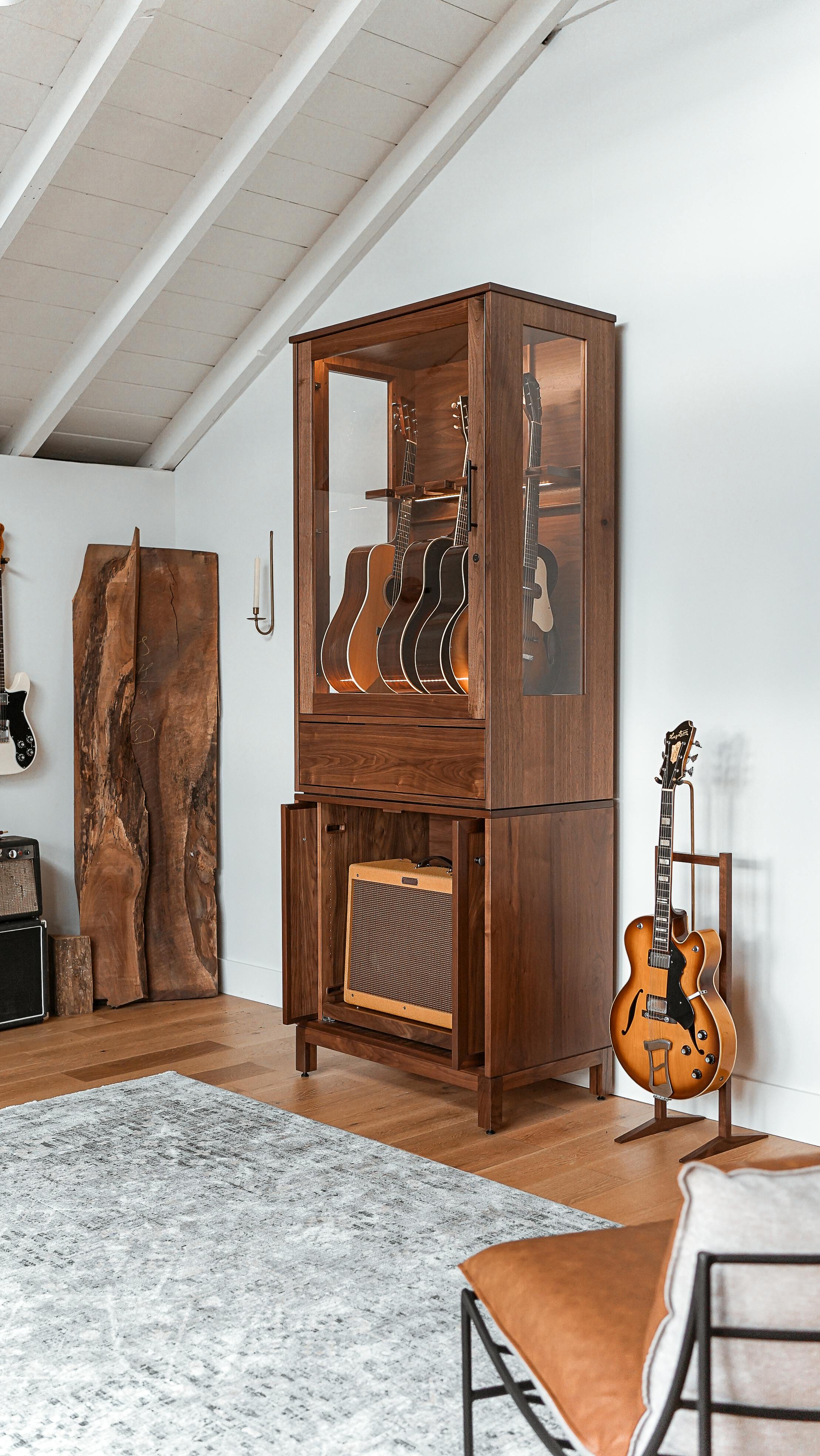
The Guitar Estate combines the Guitar Habitat’s humidified guitar display with a fully customizable gear storage credenza below. This is the most complete music room centerpiece available — instruments, amplifiers, pedals, and accessories all housed in a single, unified cabinet.
Lower section configurations include:
- Solid wood doors or pocket doors
- Drawers
- Sliding amplifier tray with power
- Pedalboard trays
- Adjustable shelving
Custom Guitar Humidor Built-Ins
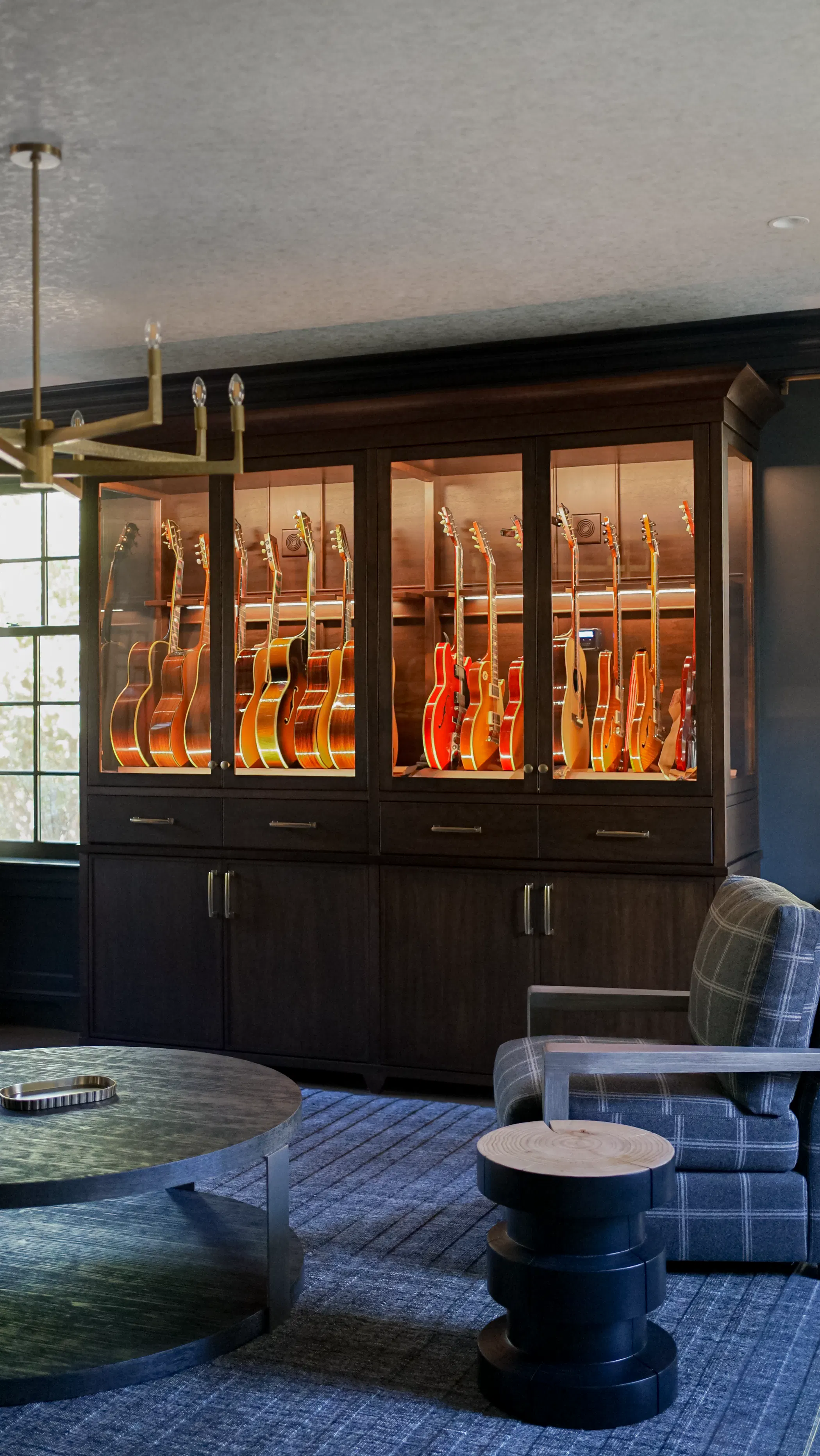
For large collections or dedicated music room installations, AMF’s custom shop designs and builds floor-to-ceiling instrument humidor systems that integrate directly into the architecture of the space. Custom projects have included installations for major recording studios, museum displays, and private collector spaces housing dozens of instruments.
Explore Custom Built-Ins Start a Custom Inquiry
Guitar Humidor for Acoustic vs. Electric Guitars
A common misconception is that only acoustic guitars require humidity-controlled storage. In reality, every guitar built from wood benefits from a stable humidity environment. Electric guitars — particularly vintage instruments, those with nitrocellulose finishes, and hollow or semi-hollow body models — are meaningfully affected by humidity fluctuations.
The ideal RH range is identical for acoustic and electric guitars: 45% target, 40–60% safe range.
The practical difference is that acoustic guitars tend to show humidity damage more dramatically and sooner. Electric guitars suffer quietly — until sharp fret ends, finish checking, or glue joint failure makes the problem impossible to ignore.
A guitar humidor protects both instrument types equally.
Read more: Do Electric Guitars Need to Be Humidified?
Guitar Humidor for Collectors and Investors
For collectors holding guitars as investment assets, humidity control isn’t a lifestyle amenity — it’s the foundation of value preservation.
A crack in a guitar top from a dry winter can reduce a guitar’s value by 30–50%. A properly documented history of climate-controlled storage, by contrast, supports maximum auction and resale valuations. At the highest levels of the guitar market — where a 1959 Gibson Les Paul “Burst” commands $300,000–$600,000 and a vintage pre-war Martin D-45 can exceed $400,000 — the cost of a proper instrument humidor represents a fraction of the value it protects.
Our recent detailed exploration of this topic: Guitars as Investments: The Ultimate Guide to Building and Protecting Your Collection
Guitar Humidor FAQs
What humidity level should a guitar humidor maintain? The target is 45% RH at 70°F. The safe operating range is 40–60% RH.
How often do I need to refill the humidifier in a guitar humidor? AMF’s Guitar Habitat and Guitar Estate require a water refill approximately once every 4–6 weeks under normal conditions.
Can a guitar humidor be used for acoustic and electric guitars together? Yes. The ideal humidity range is the same for all guitar types, and AMF cabinets accommodate all instrument sizes and body shapes.
Do I need a guitar humidor if I live in a humid climate? Potentially yes — but for dehumidification rather than humidification. AMF offers an optional integrated dehumidification upgrade for clients in climates with sustained RH above 60%.
Are guitar humidors loud? AMF’s active humidification system operates at approximately the noise level of a laptop fan — suitable for recording environments and quiet home spaces.
What’s the difference between a guitar humidor and an instrument humidor? Nothing — the terms are interchangeable. “Instrument humidor” is simply a broader way of referring to the same category of climate-controlled enclosure. All AMF guitar humidors are built to the same standard of active humidity management regardless of what you call them.
What’s the difference between a guitar humidor and a guitar display cabinet? A guitar humidor specifically refers to a climate-controlled enclosure with active humidity management. A guitar display cabinet may or may not include active humidity control. All AMF cabinets with humidification capability are genuine guitar humidors.
Ready to protect your collection with the right guitar humidor?
Shop All Guitar Humidors | Contact Our Team | Explore the Full Collection